
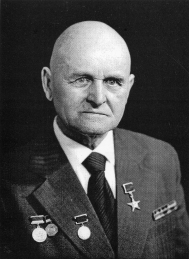
(1906-1991)
The historical development of scientific research shows that solving important scientific problems requires the involvement and unification of large teams of researchers. Thanks to their efforts and work, new technologies, new substances and materials have been developed, and physical and chemical properties and theoretical laws have been clarified. But such scientific teams have always been united around one scientist, a researcher who was a generator of scientific ideas and inspired others to achieve and implement the almost impossible. Vasyl Ivanovych Atroshchenko, a talented scientist, educator, science organiser and public figure, was one of these scientists. To fully understand the significance of this personality and his contribution to the development of inorganic substances and bonded nitrogen technology, it is necessary to find out the source and foundation of this person’s formation as a scientist in the chemical industry
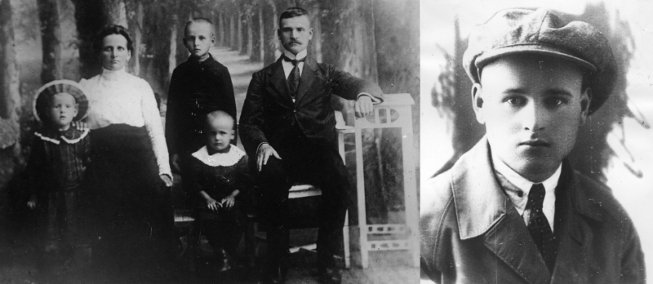
Vasyl Ivanovych Atroshchenko was born on 3 July (17) 1906 in Yuzivka (now Donetsk). Yuzivka (now Donetsk) in the family of Ivan Atroshchenko, a railway switchman at the Novo-Smolyaninovsky mine of the metallurgical plant. This was the first child, and then the family was replenished with two more children – Vasyl Ivanovych’s brother and sister. The father was a poor peasant who had previously come from his native Smolensk village of Plotki to work in Donbas.
After 1917, the young country faced difficult times: devastation, hunger, cold, and epidemics. In 1919, Vasyl Ivanovych’s mother died of typhus, and the young man, who was already working as an apprentice in mechanical workshops, had to take on the heavy burden of helping his father raise his younger brother and sister.
The famine forced the whole family to go to his father’s relatives in the Smolensk region in the village of Plotki. Plotki, Yelnynsky district, Smolensk province. There Vasyl learnt carpentry and from 1921 to 1923 he worked as an apprentice carpenter in a handicraft workshop. In 1923, the family returned to Donbas and he continued to work as a carpenter at the reconstruction of the nitrogen-chemical plant in Yuzivka. In 1924, Vasyl Ivanovych became a Komsomol member, and in 1925, at the age of 19, he was accepted as a member of the party and took an active part in the plant’s public work.
At the same time, in the evenings, he attended a two-year vocational course for masters of the nitrogen and coke industry. Upon completion of the course, Vasyl Ivanovych was transferred to the position of laboratory assistant at the central laboratory of the nitrogen and chemical plant, where he worked until 1927.
In 1927, the plant received vouchers for young workers to study at commercial, agricultural and chemical educational institutions. Vasyl Ivanovych chose chemistry and, on the recommendation of the head of the nitrogen and chemical plants, passed the competitive exams and in 1927 entered the Odesa Higher Technical School of General Applied Chemistry, a higher education institution of Ukraine with a narrow specialisation, which at that time was called technical schools, where he studied from 1922 to 1929. In 1929, the college was reorganised and split into two institutes – the Odesa Institute of Chemical Technology (now Odesa National Polytechnic University) and the Odesa Food Institute (now the Odesa State Academy of Refrigeration).
At first, it was very difficult to study at the institute for a working-class boy with only a 6-year general education. But thanks to his hard work and his abilities, he is at the forefront of both his studies and the university’s social life.
Vasily Ivanovich’s engineering skills and aptitude for research and development were evident very early on. While still a first-year student, during his first internship at the Konstantinovka Chemical Plant in the sodium sulphide (Na2S) shop, he organised production control in such a way that it significantly reduced the consumption rates of sodium sulphate Na2SO4 and coal, which allowed workers to receive additional bonuses. In the second month of his internship, student V.I. Atroshchenko was appointed acting shop manager and made a number of other significant improvements to the technology. The plant believed that when a student was a trainee, he was already a graduate, not a freshman. As Vasyl Ivanovych wrote in 1963, his passion for scientific research came to him very early: “I started experimenting back in my student days, when I did my internship at the Kostiantynivka Chemical Plant. There, I was offered a temporary position as a workshop manager. At that time, the plant received new raw materials. The chief engineer asked me, a newly minted shop manager, whether it could be used. Without hesitation, I said that the raw material was suitable.
So instead of testing it on one of the units, I loaded all the furnaces with it. Half an hour later, flames began to burst from them, knocking out the dampers. It caught fire above the roof. Firefighters were called.
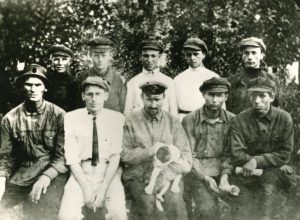
I didn’t sleep that night, looking for a mistake… and I found it. One of the ten analyses I hadn’t done hadn’t taken into account the new organic compound. In the morning, I reported my mistake to the chief engineer and made a proposal to load the furnaces with a mixture of old and new charge. They believed me. There were no more explosions. On the contrary, the shop sharply increased its output, and I was invited to work permanently. It was only now that the plant managers found out that I was a freshman, not a graduate…”
Thus, the formation of a creative personality, scientific initiative and generous talent in the organisation of science and training of personnel for the chemical industry began at the institute.
While receiving his higher education at the Odesa Institute of Chemical Technology, V.I. Atroshchenko studied under the guidance of well-known scientists and teachers: Prof. P.I. Petrenko-Krytchenko (organic chemistry), Prof. P.N. Pavlova (physical chemistry), Prof. K.I. Bakova (mathematics), Prof. E.K. Lopatto (technology), Prof. I.E. Adadurov (technology).