
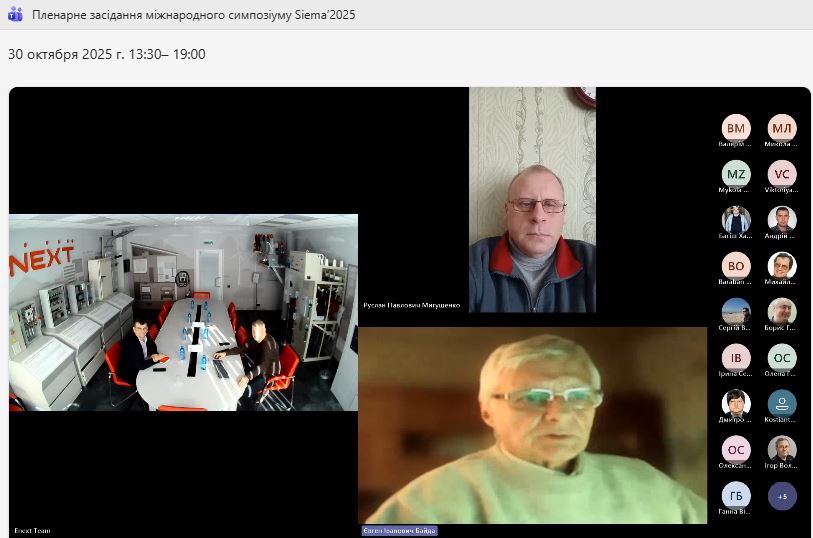
On October 30–31, 2025, the XXVIII International Scientific and Technical Symposium
“Problems of Electric Power Engineering, Electrical Engineering and Electromechanics” (SIEMA’2025) was held at the National Technical University “Kharkiv Polytechnic Institute”, Kharkiv, Ukraine.
The symposium was conducted in a hybrid format, combining remote participation with on-site elements using the Microsoft Teams platform, ensuring continuous scientific communication and broad international representation.
A total of 247 participants attended the symposium, including 105 representatives from other cities of Ukraine and international research institutions (Germany, Canada, Switzerland, Belgium). Participants included academic staff, researchers, young scientists, doctoral students, and industry representatives.
On the first day of the symposium (October 30, 2025), an international round table was held on the topic:
“Computational Electromagnetics and Multiphysics: In-House Research Codes, Commercial Software and Open-Source Software – A Comparative Analysis.”
The round table aimed to discuss the current state and development prospects of software tools for numerical modeling of electromagnetic fields and multiphysics processes, as well as to analyze trends in integrating artificial intelligence methods into scientific and engineering research.
Leading international experts participated in the round table:
- Prof. Markus Clemens (University of Wuppertal, Germany)
- Prof. David A. Lowther (McGill University, Canada)
- Prof. Stefan Kurz (Bosch Center for Artificial Intelligence / ETH Zürich, Germany–Switzerland)
- Prof. Christophe Geuzaine (University of Liège, Belgium)
- Prof. Herbert De Gersem (Technical University of Darmstadt, Germany)
The round table was coordinated by Dr. Yevhen Baida, D.Sc., Associate Professor, Head of the Department of Electrical Apparatus, NTU “KhPI”, and Dr. Michael G. Panteliat, PhD, Associate Professor of the same department, also participated as a moderator of the discussion.
During the discussion, topics such as the verification and reliability of numerical results, software openness, intellectual property rights, and the possibilities and limitations of artificial intelligence methods in electromagnetic and multiphysics modeling were addressed.
It was emphasized that all classes of software play important and complementary roles in modern research. Commercial software provides stability, scalability, and industrial orientation; open-source software ensures transparency, reproducibility, and rapid implementation of innovations; in-house research codes remain a key tool for the development and testing of new numerical methods.
Special attention was paid to the reliability of numerical results, model quality control, funding agencies’ requirements regarding software openness, as well as the proper citation of software in scientific publications.
Significant interest was raised regarding the role of artificial intelligence and machine learning methods. Participants agreed that hybrid approaches, combining physics-based numerical models with AI methods, are the most promising. At the same time, the need to preserve model interpretability and careful use of data in computational studies was emphasized.
In summary, the experts noted that the further development of computational electromagnetics and multiphysics will require closer international collaboration, development of open scientific tools, and active involvement of young researchers in interdisciplinary fields at the intersection of physics, mathematics, numerical methods, and artificial intelligence.
On the second day of the symposium (October 31, 2025), seven scientific sections were held, covering the results of fundamental and applied research in the following areas:
- Theoretical Electrical Engineering
- Theory and Practice of Electrical Machines
- Theory and Practice of Electrical Apparatus
- Strong Electric and Magnetic Fields
- Insulation, Cable, and Fiber-Optic Technology
- Electric Power Transmission, Automation, and Cybersecurity of Energy Systems
- Electric Transport
During the sectional meetings, contemporary problems of theoretical electrical engineering, numerical analysis of electromagnetic fields, design and modeling of electrical machines and apparatus, strong electric and magnetic fields, insulation, cable, and fiber-optic technology, power transmission, automation, and cybersecurity of energy systems, as well as electric transport, were discussed.
Participants’ presentations addressed issues of improving the energy efficiency of electrotechnical systems, enhancing mathematical and computational modeling methods, ensuring reliability and safety of power equipment, and implementing modern digital technologies in research and engineering practice. Significant attention was given to the practical application of scientific results in industry and the energy sector.
The sectional meetings were conducted in an interactive format, promoting the exchange of experience between domestic and international researchers, establishing new professional contacts, and identifying prospective directions for future joint research. Special attention was given to the active participation of young scientists and doctoral students, for whom the symposium provided a platform to present their own scientific achievements and professional development.
Conclusions
- SIEMA’2025 confirmed the high scientific level and relevance of research in the fields of electric power engineering, electrical engineering, and electromechanics.
- The international round table demonstrated the feasibility of using commercial, open-source, and in-house research software in modern scientific studies.
- The growing role of interdisciplinary approaches, particularly the combination of physics-based numerical models with AI methods, was recognized.
- The discussions contributed to the deepening of international cooperation and the establishment of joint scientific initiatives.
- The symposium created conditions for the active involvement of young researchers and doctoral students in relevant scientific and technical research.
Recommendations
- Continue holding international round tables within the SIEMA symposium to discuss strategic scientific directions.
- Promote the development of open and reproducible scientific software tools in national and international research projects.
- Strengthen inter-university and interdisciplinary cooperation, particularly in hybrid modeling and digital technologies.
- Expand participation of young scientists in international scientific events by integrating symposium outcomes into educational and research programs.
- Utilize symposium results for the development of future research topics and the preparation of project proposals.
The symposium materials are published in the Book of Abstracts “Problems of Electric Power Engineering, Electrical Engineering and Electromechanics” (SIEMA’2025), prepared by the Department of Electrical Apparatus, NTU “KhPI”.
The abstract book is also available on the symposium website (link provided).