Educational and Research Program “Intelligent Data Analysis”
Field of Knowledge: F – Information Technology
Specialty: F1 – Applied Mathematics
Qualification: Master of Applied Mathematics
1. PROFILE OF THE EDUCATIONAL AND RESEARCH PROGRAM
1 – General Information
Full name of the Higher Education Institution and Institute
National Technical University “Kharkiv Polytechnic Institute”
Department of Computer Mathematics and Data Analysis
Level of Higher Education and Qualification Title in the Original Language
Master of Applied Mathematics
Cycle / Qualification Level
Ukrainian NQF – Level 8 (Master), FQ-EHEA – Second Cycle, EQF-LLL – Level 7
Official Title of the Educational Program
Educational and Research Program “Intelligent Data Analysis”
Degree Type and Program Scope
Master’s diploma, single, 120 ECTS credits, duration – 1 year and 9 months
Accreditation
Accreditation Commission of Ukraine. Certificate – ND № 8536 dated May 28, 2024, valid until July 1, 2029
Prerequisites
Bachelor’s degree
Language(s) of Instruction
Ukrainian
Validity Period of the Educational Program
According to the accreditation certificate validity
Reviewed annually
Link to the permanent placement of the educational program description
http://web.kpi.kharkov.ua/
2 – Objective of the Educational Program
The program aims to train research specialists in the field of applied mathematics who are capable of formulating, solving, and generalizing complex problems in their professional activities, and of conducting professional, innovative work for scientific and project tasks, using fundamental and specialized methods of mathematics and computer science, developing mathematical models and algorithms, as well as creating and operating software.
The educational program is designed to prepare research specialists proficient in mathematical methods and information technologies of machine learning and artificial intelligence for searching, analyzing, processing, and visualizing data, including measurement and observational data, texts, signals, and images, for the purpose of knowledge extraction, forecasting, and decision-making.
3 – Program Description
Subject Area (Field of Knowledge, Specialization)
Field of Knowledge: F – Mathematics and Statistics
Specialization: F1 – Applied Mathematics
Program Orientation
The educational and research program is scientifically focused on the study, development, and application of mathematical methods, models, and algorithms based on machine learning and artificial intelligence.
Professional focus – development of software for the analysis of data, processes, texts, signals, and images, forecasting and decision-making, knowledge discovery and extraction.
Main Focus of the Program
Specialized education in the field of mathematics and statistics under the F1 – Applied Mathematics specialty, focused on the subject area of intelligent analysis of large, uncertain datasets using machine learning and artificial intelligence methods.
Keywords: data analysis, signal and image processing, pattern recognition, information retrieval, big data, knowledge extraction, mathematical models, machine learning, artificial and computational intelligence.
Program Features
An experimental, project-based educational and research program. Project-based learning through integrated academic and real-world projects. Dual education at partner enterprises (leading IT companies). Individualized learning with a student-centered approach. Several courses taught in English.
4 – Graduates’ Employability and Further Education
Employability
Employment in enterprises and companies of the IT industry, in information and analytical departments of manufacturing and banking-financial sectors, research institutions, and higher education institutions.
Professional opportunities for graduates (in accordance with the National Classifier of Occupations DK 003:2010):
212 – Professionals in mathematics and statistics;
2121 – Mathematics professionals;
2121.1 – Research associates (mathematics);
2121.2 – Mathematician (applied mathematics), operations research analyst;
2149.2 – Research engineer (applied mathematics);
213 – Computing professionals;
2132 – Programming professionals;
2132.2 – Software developers.
Initial positions: research associate, applied mathematician, data analyst, systems analyst, software developer.
Further Education
Opportunity to pursue education at the third (educational and scientific) level of higher education (Level 9 of the National Qualifications Framework) within Doctor of Philosophy (PhD) programs.
Opportunities for postgraduate education to obtain professional qualifications according to relevant professional standards.
5 – Teaching and Assessment
Teaching and Learning
Lectures, laboratory and practical sessions, research and practice seminars, execution of academic and real-world projects, problem-based and inquiry-based learning, student-centered learning, dual education, distance and blended learning, independent work and self-study, internships, and preparation of the qualification paper.
Assessment
Rating-based assessment system. Continuous and final knowledge assessment (quizzes, tests, individual assignments, etc.), credit assessments and examinations (oral and written), defense of academic and real-world projects with presentations, public defense of the qualification paper.
6 – Program Competences
| Integrated Competence |
| The ability to solve complex problems and tasks in applied mathematics in professional activities or during learning, characterized by uncertainty of conditions and requirements, involving conducting research and/or implementing innovations, and requiring the application of mathematical theories, methods, algorithms, information technologies, and specialized software. |
| General Competences (GC) |
| GC 1 |
Ability to exercise one’s rights and responsibilities as a member of society, to be aware of the values of a civil (free and democratic) society, and to understand the necessity of its sustainable development, the rule of law, and human and civil rights and freedoms in Ukraine. |
| GC 2 |
Ability to preserve and enhance moral, cultural, and scientific values and achievements of society based on understanding the history and development patterns of the field, its place within the general system of knowledge about nature and society, and its role in the development of society, technology, and engineering. |
| GC 3 |
Ability for continuous learning, acquiring new knowledge and skills, including in areas different from one’s professional field. |
| GC 4 |
Ability to identify, formulate, and solve problems in professional activities. |
| GC 5 |
Ability to generate new ideas (creativity) and unconventional approaches to their implementation, to adapt flexibly to real professional situations, and to demonstrate initiative and a creative approach. |
| GC 6 |
Ability to critically evaluate and reconsider accumulated experience (own and others’), analyzing one’s professional and social activities. |
| GC 7 |
Ability to work with information: to find and use information from various sources necessary for solving professional tasks. |
| GC 8 |
Ability to communicate effectively based on the goals and context of interaction. |
| GC 9 |
Ability to prepare and deliver public presentations of results, and to prepare scientific and technical publications based on completed research, including in a foreign language. |
| GC 10 |
Ability to conduct professional, scientific, and project-production activities in an international environment. |
| GC 11 |
Ability to interact socially and professionally, collaborate in teams, and work effectively in a group. |
| Professional Competencies of the Specialization (determined by the higher education institution) |
| PCS 1 |
Ability to formulate the mathematical statement of a problem based on the terminology of the subject area and to verify the correctness of the formulation, including under conditions of uncertainty. |
| PCS 2 |
Ability to select, develop, and investigate a mathematical analytical or numerical method for solving practical problems that ensures the required accuracy and reliability of the results. |
| PCS 3 |
Ability to select, develop, investigate, and apply mathematical methods for solving practical problems of modeling, design, control, forecasting, and decision-making. |
| PCS 4 |
Ability to develop algorithms for the analysis of large uncertain datasets, create corresponding software tools and documentation, and design software systems, databases, and knowledge bases. |
| PCS 5 |
Ability to perform mathematical and computer modeling and computational experiments, collect, visualize, analyze, and process obtained data, and solve formalized problems using specialized software tools. |
| PCS 6 |
Ability to coordinate a team in conducting research and project development, and to make effective, economically justified organizational and managerial decisions. |
| PCS 7 |
Ability to search for, study, and analyze scientific and technical information, both domestic and international, related to the application of mathematical methods for the study of processes and systems. |
| PCS 8 |
Ability to participate in the preparation of scientific and technical reports on completed project or research work and in the implementation of the results of conducted research and development. |
| PCS 9 |
Ability for effective professional written and oral technical and scientific communication in the subject area in Ukrainian and one of the common European languages. |
| PCS 10 |
Ability to select, develop, investigate, and apply mathematical models and methods for intelligent data analysis under conditions of uncertainty. |
| PCS 11 |
Ability to develop, investigate, and apply mathematical methods and machine learning algorithms, soft computing, and computational intelligence for the analysis of uncertain data, forecasting, and decision-making. |
| PCS 12 |
Ability to develop and operate specialized software tools for intelligent analysis of data, texts, signals, and images. |
| PCS 13 |
Ability to develop and operate specialized software tools for processing large datasets based on distributed and cloud computing technologies. |
| PCS 14 |
Ability to use modern information technologies for intelligent data analysis, forecasting, decision-making, information retrieval, and knowledge extraction. |
7 – Program Learning Outcomes
| PLO 1 |
Demonstrate knowledge and understanding of the fundamental concepts, principles, and theories of fundamental and applied mathematics, and apply them in practice. |
| PLO 2 |
Be able to formalize problems formulated in the language of a specific subject area, select a rational method for solving them, apply analytical or numerical methods, evaluate the accuracy and reliability of the obtained results, and interpret them. |
| PLO 3 |
Possess methods for developing, studying, and applying mathematical models of complex objects and processes, including through computational intelligence techniques. |
| PLO 4 |
Be able to combine mathematical and computer modeling methods with informal procedures of expert analysis to find optimal solutions. |
| PLO 5 |
Design algorithms for numerical research of mathematical models and data analysis that are efficient in terms of computational accuracy, stability, performance, and resource consumption. |
| PLO 6 |
Be able to select, develop, and study methods and algorithms for solving mathematical problems in system optimization, operations research, optimal control, and decision-making. |
| PLO 7 |
Be able to apply modern programming technologies and software development tools for the implementation of numerical and symbolic algorithms. |
| PLO 8 |
Be able to use specialized software products and computer mathematics systems, as well as big data analysis tools, in practical work. |
| PLO 9 |
Demonstrate effective teamwork and interpersonal communication skills, interact productively with professionals and society, and manage conflicts and stress. |
| PLO 10 |
Collect, process, and analyze scientific and technical information ethically, avoiding plagiarism; prepare well-structured presentations, reports, and publications. |
| PLO 11 |
Demonstrate professional communication skills, both oral and written, in Ukrainian and at least one other European language. |
| Program Learning Outcomes by Specialization (defined by the higher education institution) |
| SPLO 1 |
Know and understand modern methods for solving mathematical problems in statistical and intelligent data analysis, forecasting, and related areas. |
| SPLO 2 |
Know and understand methods for solving mathematical problems in intelligent information retrieval and knowledge discovery. |
| SPLO 3 |
Be able to apply existing and develop new algorithms and software tools for statistical and intelligent analysis of uncertain data. |
| SPLO 4 |
Be able to apply existing and develop new algorithms and software tools for processing data, texts, signals, and images. |
| SPLO 5 |
Be able to apply modern information technologies and software for processing large datasets using distributed and cloud-based services. |
8 – List of Components of the Educational and Professional Program
The list and content of educational components (general, special, professional, and elective) can be found in the curriculum via the provided link.
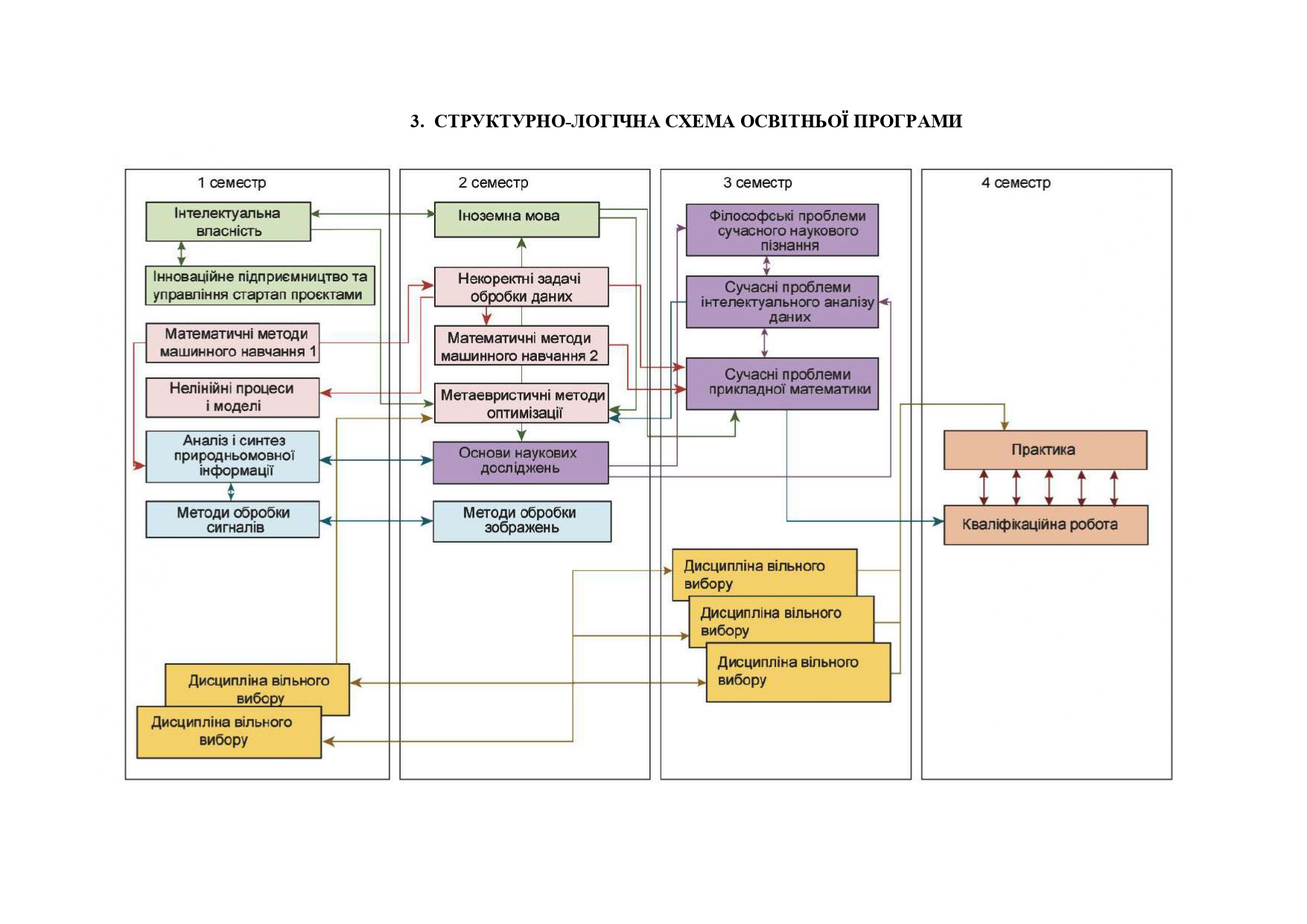
9 – Structural and Logical Scheme
10 – Form of Final Certification of Higher Education Graduates
The certification of graduates of the educational program in specialty F1 – Applied Mathematics is conducted in the form of the defense of a master’s qualification thesis and concludes with the issuance of a standard-form document conferring the degree of Master in Applied Mathematics under the educational program “Intelligent Data Analysis”. The certification is conducted openly and publicly.
2. LIST OF COMPONENTS OF THE EDUCATIONAL AND SCIENTIFIC PROGRAM AND THEIR LOGICAL SEQUENCE
Full content of the educational programs:
Additional Information: