Educational and Scientific Program Intellectual Data Analysis
Field of study: F – Information Technology
Specialty: F1 – Applied Mathematics
Qualification: Doctor of Philosophy in Applied Mathematics
Guarantor of the educational program: Stanislav Viktorovych Pohorielov
1. PROFILE OF THE EDUCATIONAL AND SCIENTIFIC PROGRAM “INTELLECTUAL DATA ANALYSIS” IN THE SPECIALTY F1 “APPLIED MATHEMATICS”
Higher educational institution and structural unit Higher education degree and title of qualification in the original language Official name Type of diploma and scope of the educational program Availability of accreditation Cycle / level of the program Prerequisites Language(s) of instruction Duration of the educational program Internet address of permanent placement of the description of the educational program Form of study
National Technical University “Kharkiv Polytechnic Institute”, Department of Computer Mathematics and Data Analysis
Higher education degree – Doctor of Philosophy
Educational qualification – Doctor of Philosophy in Applied Mathematics
Educational and Scientific Program “Intellectual Data Analysis”, in English – “Intellectual Data Analysis”
Doctor of Philosophy diploma, single, 50 ECTS credits, duration of study – 4 years
None
Third (PhD) level of higher education; NQF of Ukraine – level 8, QF-LLL – level 8, FQ-EHEA – third cycle
Possession of a Master’s degree or a Specialist qualification level
Ukrainian, English
Until the introduction of the higher education standard
https://web.kpi.kharkov.ua/phd/zanyattya/osvitno-naukovi-programi/
Full-time / part-time
To provide training for research specialists in the field of applied mathematics who are able to generate new ideas, formulate, solve and generalize complex scientific problems and complex tasks, possess the methodology of scientific, research, innovation and pedagogical activities, carry out professional innovative activities to perform scientific and project work using fundamental and special methods of mathematical and computer sciences, conduct their own scientific research aimed at creating mathematical models, algorithms and information technologies for intellectual analysis of big data under uncertainty using artificial intelligence, machine and deep learning methods, whose results have scientific novelty, theoretical and practical significance.
Subject Area (Field of Knowledge, Specialty) Orientation of the Educational Program Program Structure Main Focus of the Educational Program Program Features
Field of knowledge: F – Information Technology
Specialty: F1 – Applied Mathematics
Educational and scientific academic
Educational and scientific program focused on research, development and application of mathematical methods, models, algorithms, and information technologies based on machine learning and artificial intelligence for data analysis.
Professional focus – development of new mathematical methods and information technologies for analyzing data, processes, texts, signals, and images, forecasting and decision-making, knowledge discovery and extraction.
The content of the educational and scientific program is oriented toward modern scientific achievements in applied mathematics and information technologies, considering regional and industry-specific features and needs. It is based on current results, trends, and prospects of applied mathematics in Ukraine and worldwide.
Specialized education in the field of information technology under the specialty F1 – “Applied Mathematics”, with an emphasis on research, development, and application of mathematical and numerical methods and information technologies in the field of intelligent data analysis, based on machine learning and artificial intelligence methods.
Keywords: data analysis, signal and image processing, pattern recognition, information retrieval, big data, knowledge discovery, deep learning, mathematical modeling, machine learning, artificial and computational intelligence.
The program emphasizes the use of modern methods of applied and computer mathematics in scientific research and project activities in the field of data mining. It is multidisciplinary and provides scientific, pedagogical, and practical training aimed at developing research, teaching, and professional skills; includes participation in research and project work; and allows for individualized learning focused on the learner. Some academic courses may be delivered in English.
Employment opportunities Further education
Employment in enterprises and companies of the IT industry, in information-analytical departments of enterprises in the manufacturing and banking-financial sectors, in research institutions, and higher education institutions.
Professional opportunities for graduates (according to the Classifier of Occupations DK 003:2010):
212 Professionals in Mathematics and Statistics
2121 Professionals in Mathematics
2121.1 Research Workers (Mathematics)
2121.2 Mathematicians (Applied Mathematics), Operations Research Analysts
2122 Professionals in Statistics
2122.1 Research Workers (Statistics)
2122.2 Professional Statisticians
213 Professionals in Computing (Computerization)
2131 Professionals in Computing Systems
2131.1 Research Workers (Computing Systems)
2132 Professionals in Programming
2132.1 Research Workers (Programming)
2132.2 Software Developers
2139 Professionals in Other Computing Fields
2139.1 Research Workers (Other Computing Fields)
2139.2 Professionals in Other Computing Fields
2310.2 Other University and Higher Education Teachers
2447.1 Research Staff (Projects and Programs)
Primary positions: Research scientist, applied mathematician, data analyst, systems analyst, software developer.
Professional titles under ISCO-08:
2310 University and Higher Education Teachers;
2120 Mathematicians, Actuaries and Statisticians;
2512 Software Developers;
2519 Software and Applications Developers and Analysts not elsewhere classified;
2521 Database Designers and Administrators;
2511 Systems Analysts;
331 Financial and Mathematical Associate Professionals;
2356 Information Technology Trainers;
351 ICT Operations and User Support Technicians.
Possibility to continue studies at the fourth (scientific) level of higher education (8th level of the NQF) in doctoral programs.
Opportunity for postgraduate education to obtain professional qualifications according to relevant professional standards.
Teaching and Learning Assessment
Lectures, laboratory and practical classes, scientific and practical seminars, implementation of educational and real-world projects, problem-based learning and inquiry-based learning, dual education, distance and blended learning via Office 365, self-study and independent work, internships, involvement in research, preparation and public defense of the dissertation.
Rating-based assessment system. Ongoing and final control of knowledge (interviews, tests, individual assignments, quizzes, etc.), credits and exams (oral and written), defense of academic and real projects with presentations, public defense of the dissertation.
Integral competenceThe ability to formulate, investigate, and solve complex problems in the field of applied mathematics in professional and/or research and innovation activities, which involves a deep rethinking of existing and the creation of new holistic knowledge and/or professional practice. Material and technical support Information and educational support International credit mobility Education for foreign students 3.2 Doctoral exam in the specialty. The main purpose of the doctoral exam is to assess the results of comprehensive professional and scientific training for scientific and pedagogical activities. It determines the postgraduate student’s acquisition of theoretical knowledge, skills, and competencies, as well as readiness for independent research. The exam, based on theoretical knowledge from the first two years and the student’s research overview, is held during the 3rd–4th year and consists of two parts. The first is a written exam evaluating theoretical knowledge in the specialty and related areas. The second evaluates research skills (question formulation, research planning, result explanation, domain competence). 3.3 Dissertation requirements. The applicant must acquire the knowledge, skills, and competencies defined by the higher education standard of the third level, conduct independent research, document it as a dissertation, and publish the main results. The dissertation must solve current problems in applied mathematics, adhere to academic integrity, and contain novel, justified research outcomes. Format requirements are set by the Ministry of Education and Science of Ukraine. The main text must be 4.5–7 author’s sheets in volume. Prior to defense, the dissertation is checked for plagiarism according to NTU “KhPI” quality assurance procedures and uploaded to the university repository. 3.4 Final certification. The final certification for the “Intellectual Data Analysis” educational-scientific program (PhD level, specialty F1 “Applied Mathematics”) takes place via a public dissertation defense. Admission requires successful completion of the individual research plan. The defense is held publicly at a specialized academic council meeting authorized to conduct a one-time defense and concludes with issuing a certificate awarding the degree of “Doctor of Philosophy in Applied Mathematics”.
General Competencies (GC)
GC 1
The ability to think abstractly, critically analyze, and synthesize new and complex ideas.
GC 2
The ability to acquire conceptual and methodological knowledge in a field or at the border of fields of knowledge or professional activity, continuous self-development and self-improvement.
GC 3
The ability to acquire professional skills and abilities of a researcher necessary to solve significant problems in the field of professional activity, science and/or innovation, to organize and conduct scientific research at a modern level and to implement science-intensive projects.
GC 4
The ability to generate new ideas (creativity).
GC 5
The ability to form a systematic scientific worldview and general cultural outlook, adherence to professional ethics and academic integrity.
GC 6
Ability to orally and in writing present the results of one’s own scientific research in Ukrainian, search for and critically analyze information from various sources, manage scientific projects and/or prepare proposals for funding scientific research and obtaining grants, and register intellectual property rights.
GC 7
The ability to use academic Ukrainian and foreign languages in professional activities and research, to present and discuss the results of one’s scientific work orally and in writing, as well as to fully understand foreign-language scientific texts in professional activities.
GC 8
The ability to acquire professional skills in teaching and organizing the educational process, master modern pedagogical methods and technologies, and use modern psychological and pedagogical theories and methods in professional, teaching, and scientific activities.
Special (professional) competencies of the specialty (defined by the higher education standard of the specialty for the PhD level)
SC 1
Ability to conduct research on the application of applied and computer mathematics methods to solve applied tasks and significant problems, develop knowledge-intensive projects in the field of professional activity, science and/or innovation.
SC 2
Ability to improve existing and develop new methods of applied and computer mathematics, relevant numerical methods and algorithms, and their implementation using modern information technologies.
SC 3
Ability to use and improve existing and create new specialized problem-oriented software for modeling, intelligent analysis of big data, and creation of artificial intelligence systems based on distributed and cloud computing information technologies.
SC 4
The ability to obtain, analyze, verify the reliability of research results and apply them to formulate recommendations when solving applied practical problems in the field of professional activity
SC 5
Ability to organize the work of a team of performers to conduct scientific research and develop science-intensive projects, to work collectively in an international scientific environment, and to make appropriate and economically sound organizational and managerial decisions.
Special (professional) competencies of the specialty (defined by the ESP)
SC 6
The ability to select, develop, research and apply mathematical methods, models and algorithms of machine and deep learning, soft computing and computational intelligence for intelligent data analysis, forecasting, decision-making, information retrieval and knowledge extraction under uncertainty.
SC 7
Ability to develop and operate specialized software tools for processing large data sets based on distributed and cloud computing information technologies.
LR 1
Demonstrate the acquisition of a systematic scientific worldview and general cultural outlook, consistent adherence to professional ethics and academic integrity.
LR 2
Apply abstract thinking to analyze, synthesize and generate scientific ideas, concepts, and theories in the direction of scientific research in the field of professional activity; have the skills to verify and apply them.
LR 3
Be able to plan and carry out their own scientific research in the field of applied mathematics, formulate and test hypotheses, choose methods and tools, analyze results, and justify conclusions.
LR 4
Demonstrate knowledge and understanding of the basic concepts, principles, and theories of applied mathematics and the ability to use them in practice to solve practical problems and create new information technologies.
LR 5
Be able to formalize problems formulated in the language of a specific subject area, choose a rational method for solving applied practical problems; solve problems using analytical or numerical methods, evaluate the accuracy and reliability of the results obtained and interpret them.
LR 6
Be able to apply existing and develop new mathematical methods, models and algorithms of machine learning, soft computing and computational intelligence for statistical and intelligent data analysis, forecasting, decision-making, information search and knowledge extraction.
LR 7
Be able to apply and improve existing information technologies and software, develop new algorithms and software tools for processing data, texts, signals and images that are effective in terms of calculation accuracy, stability, speed and cost of system and computing resources, including for processing large data sets based on distributed and cloud services.
LR 8
Demonstrate acquired skills in oral and written presentation of the results of one’s own scientific research, preparation of scientific publications, search, systematization and critical analysis of information from various sources, management of scientific projects and preparation of proposals for financing scientific research, registration of intellectual property rights.
LR 9
Be able to work in a team, organize the work of a scientific team when performing scientific research, applied research and development, implementing projects, particularly in an international environment, and make appropriate and economically justified organizational and managerial decisions.
LR 10
Demonstrate professional communication skills, oral and written communication in Ukrainian and at least one other European language to a level sufficient to freely present and discuss the results of scientific work, as well as to fully understand foreign-language scientific texts in the subject area.
LR 11
Be able to conduct pedagogical activities in higher education institutions, develop educational and methodological materials in the specialty, teach professional disciplines in the specialty “Applied Mathematics” using modern pedagogical methods and teaching technologies.
The human resource of the ESP complies with Resolution No. 1187 of the Cabinet of Ministers of Ukraine dated December 30, 2015, “On Approval of Licensing Conditions for Educational Activities of Educational Institutions” (as amended by Resolution No. 365 of March 24, 2021, Appendices 15–16).
Complies with the requirements for material and technical support for educational activities in the field of higher education in accordance with the current legislation of Ukraine (Resolution of the Cabinet of Ministers of Ukraine dated December 30, 2015, No. 1187, as amended by Resolution No. 365 of March 24, 2021, Appendix 17). Classrooms and multimedia equipment are available.
Complies with the requirements for information and educational support for educational activities in the field of higher education in accordance with current Ukrainian legislation (Resolution of the Cabinet of Ministers of Ukraine dated December 30, 2015, No. 1187, as amended by Resolution No. 365 of March 24, 2021, Appendix 18). Teachers and students have access to the library of NTU “KhPI” and its repository, as well as to the departmental library.
Based on bilateral agreements between the National Technical University “Kharkiv Polytechnic Institute” and leading technical universities of Ukraine. Regulated by the “Regulations on Academic Mobility of Students, Postgraduate Students, Doctoral Students, Scientific and Pedagogical and Research Workers of NTU”.
Based on bilateral agreements between the National Technical University “Kharkiv Polytechnic Institute” and higher education institutions of foreign partner countries.
Possible after students have completed a Ukrainian language course.
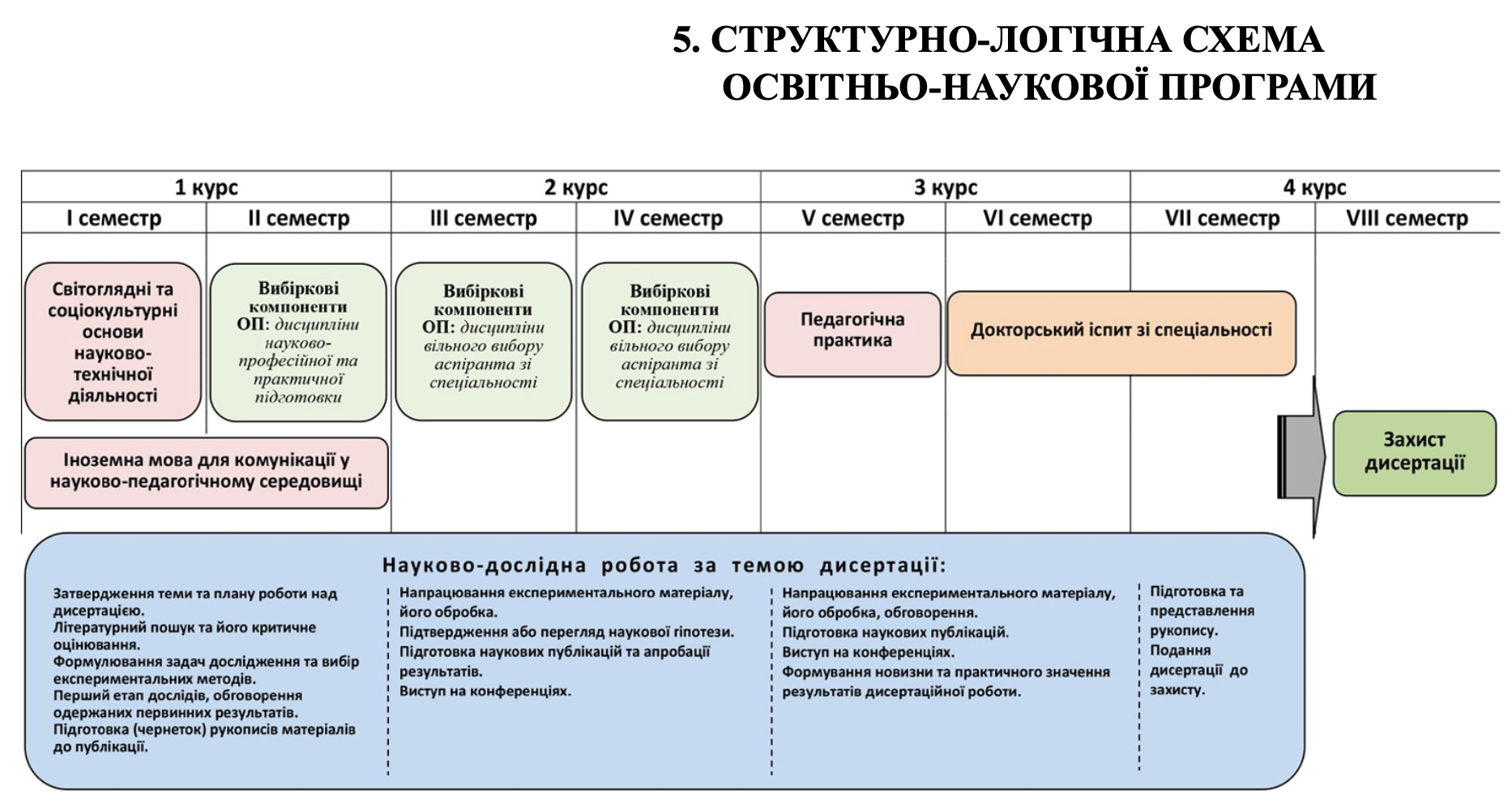
2. LIST OF COMPONENTS OF THE EDUCATIONAL AND SCIENTIFIC PROGRAM AND THEIR LOGICAL SEQUENCE
🔹 List of components of the educational and scientific program
🔹 Structural and logical diagram
Full content of educational programs:
🔹 Educational and scientific program “Intellectual Data Analysis” of the third (Doctor of Philosophy) level of higher education (postgraduate studies) 202/202 academic year
Additional information:
🔹 Curriculum